Celebrating Innovation and Advocacy: A Recap of the Inaugural Google Canada Business Summit

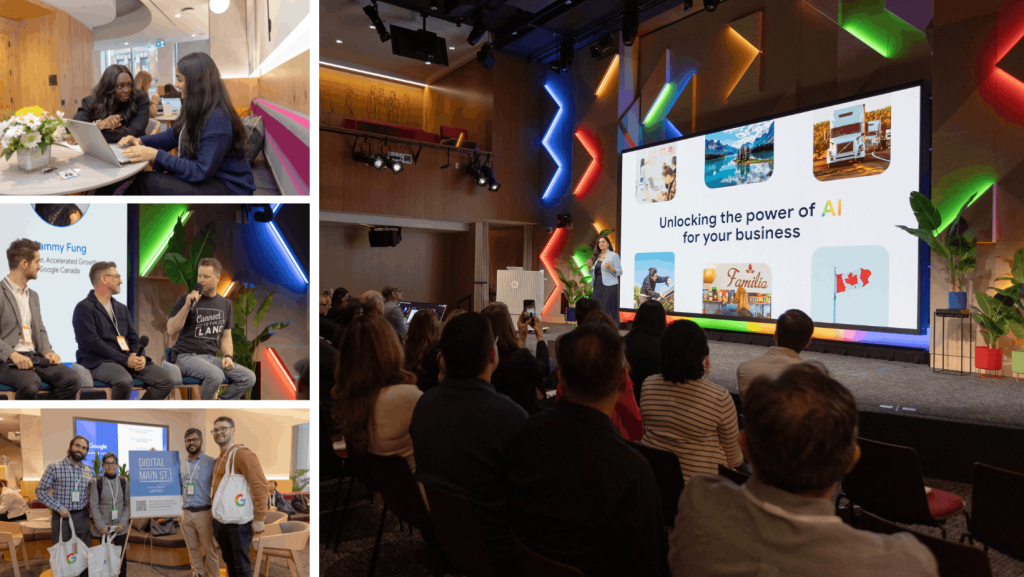
Over 70 business and community leaders from across Canada gathered in Toronto for the inaugural Google Canada Business Summit, hosted in partnership with Digital Main Street. The day spotlighted how AI is unlocking new opportunities for small businesses to streamline operations, elevate marketing, and reach more customers. It also reinforced a powerful message: small business voices are essential in shaping the future of our digital economy.
On February 26th, 2026, Digital Main Street was proud to partner with Google Canada to host the first-ever Google Canada Business Summit in Toronto. The event brought together over 70 business and community leaders from 28 cities across the country, representing diverse sectors including lifestyle, beauty, food and hospitality, health, media, and agriculture.
As an organization born to help small businesses navigate the digitization journey, we at Digital Main Street know the value of technology to small businesses, but understand it can come with challenges and questions. This summit proved that the AI era is a transformative time for entrepreneurs to streamline operations, get creative with their marketing, reach new customers, and use their voices to shape the policy landscape that governs our digital economy.
Opening Remarks – John Kiru (CEO and founder, Digital Main Street, Executive Director of the Toronto Association of Business Improvement Areas)
John Kiru opened the day by reflecting on Digital Main Street’s 10-year journey of supporting 130,000 small businesses across Canada with their digital adoption. He emphasized that Google Canada has been a dedicated partner in this mission since day one of the organization. John reminded the audience that AI technologies are not exclusive to large corporations; they are practical, everyday instruments designed to help small business owners level the playing field.
Unlocking the Power of AI for your Business – Natasha Walji (Managing Director, Google Customer Solutions Canada)
Natasha Walji began by sharing that the small business journey is personal to her. Having grown up with parents who were both entrepreneurs, Natasha explained that she understands firsthand the sweat equity, care, and creativity required to run a business. Her journey began sweeping floors at her mother’s flower shop in Calgary in the pre-internet era, later transitioning into the tech space as a lead product developer for her father’s fintech startup.
Natasha highlighted that we are currently in the third major technological shift – following the internet and mobile – and AI is the “great equalizer” and the most transformative era yet. She emphasized that Google Canada’s mission is to think about AI in a bold way, while considering responsibility at the same time, shown through Google’s AI principles of security, privacy and trust. With the potential to boost Canada’s economy by $230 billion and save the average worker 170 hours a year, Natasha shared that the opportunity for small businesses is massive.
To help businesses navigate this, Natasha introduced the AI Five to Thrive:
- Be easily found by AI-driven search: With 80% of customers going online before visiting a store, a strong digital presence is non-negotiable.
- Boost operations with Gemini: From summarizing long email threads to drafting customized marketing messages, Gemini helps you regain your time.
- Supercharge profit-driven marketing with AI: Use AI tools to move beyond linear funnels and capture customers wherever they are.
- Find your next big idea with NotebookLM: A tool for deep research and synthesizing complex information.
- Stay curious about what’s next: Success belongs to those who lean into experimentation and learn 1% every day.
Supercharging your Marketing & Creativity with AI – Laura Pearce (Country Marketing Director, Google Canada)
Laura Pearce reminded the group that small businesses are the heart of the Canadian economy, representing 99% of all businesses. She shared the importance of democratizing access to digital tools, noting that success is no longer about the size of a business, but how quickly entrepreneurs take advantage of the technology available to them.
Central to this is understanding how consumers are arriving at your digital storefront. Laura explained that this evolution of search has fundamentally changed consumer behavior; while we once relied on a linear marketing funnel, we now see customers engaging in the “4 S’s” simultaneously- searching, scrolling, streaming, and shopping. Because these behaviors happen all at once throughout a customer's day, the journey has become significantly more complex. Laura emphasizes that this shift makes it more important than ever to leverage AI, as it allows business owners to cut through the noise and serve the right customer at the exact right time.
Laura emphasized that marketing is an investment, not an expense, and introduced tools like Nano Banana (a tool within Gemini) for creating product images and Google Ads Advisor (a new tool within Google Ads) that act like a built-in media agency to optimize campaigns based on real-time data. Expanding on this suite of creative tools, Laura introduced Pomelli, a brand-new asset creation tool designed to accelerate the creative process. By inputting your “Business DNA”- such as your website URL, brand colors, fonts, and existing imagery- Pomelli understands your brand identity and helps you generate full campaigns through simple prompts. The tool offers intelligent suggestions and allows for seamless edits using generative AI, enabling business owners to create high-impact content for their audience faster than ever before. Currently in its experimental stage, Laura said that Pomelli is being offered for free, providing a unique opportunity for entrepreneurs to test the technology and provide feedback that will shape its future iterations.
NotebookLM and Learning in the Age of AI – Sofia Remtulla (Google Cloud AI Specialist, Google Canada)
Sofia Remtulla conducted a dynamic live demo of NotebookLM, a tool that is quickly becoming an essential partner for small business owners. While many are familiar with Gemini, Sofia clarified a key distinction: whereas Gemini draws from the vastness of the open web, NotebookLM allows you to create a controlled, high-certainty environment. It grounds its AI intelligence strictly in the sources the user provides- PDFs, slides, spreadsheets, or even videos- ensuring the answers you receive are based only on information you trust. By uploading these sources a business owner can chat with their selected data to create briefs, summaries, infographics or even podcasts, in a secure platform.
To illustrate its power, Sofia shared a mock example of “The Great Outdoors,” a Vancouver-based sustainable gear company looking to expand into the European market. By uploading long, complex documents like the CanExport funding guidelines, the ISPO Trade Expo website, and their own internal income statements, the owner was able to “talk” to their data.
The tool immediately confirmed their eligibility for government funding based on their revenue and outlined specific requirements like employee headcount. Because NotebookLM provides in-line citations, the owner could see exactly which page of which document the information came from, eliminating the guesswork often associated with long government manuals.
Beyond simple Q&A, the tool’s reasoning models allow for strategic planning. The owner used it to:
- Maximize Funding: NotebookLM broke down the lengthy CanExport guide into a step-by-step plan to get the most out of their Amsterdam trip.
- Draft Applications: It helped generate a project justification brief for the grant application, specifically aligning the business's goals with the government’s priorities.
- Visualize Strategy: Through its mind-mapping capability, the tool thematically grouped data sources to help the owner visualize the relationship between the trade show and available funding.
Sofia shared that whether you are looking for a summarized brief, an automated podcast summary, or a multimodal studio experience with infographics and slide decks, NotebookLM turns a mountain of documents into a secure, actionable workspace.
A New Era of Innovation: How Three Canadian Businesses are Unlocking Growth – Jacob Murray (Co-Owner, Topsy Farms), Mike McKenna (Co-Founder, Little Chief & Co.), and Oscar Radevsky (Founder, Create Makerspace), moderated by Cammy Fung (Accelerated Growth Manager, Google Customer Solutions Canada)
This panel brought to life the practical impact of digital tools through the stories of three very different Canadian businesses:
Topsy Farms: Jacob Murray described the challenges of running a farm at “the end of the dead end road” on Amherst Island where ferry service can act as a barrier. He described Google as the second ferry, helping customers access the farm digitally. By embracing SEO and Google tools early on, the farm reached a global audience, doubling sales repeatedly and ensuring the farm stayed in the family. Jacob said that he now views Gemini as a “divine twin” in his pocket, providing instant solutions to technical issues on the farm.
Create Makerspace: Oscar Radevsky runs a business that offers a “digital detox” through woodworking, yet he relies heavily on technology to keep the doors open, overcome barriers and solve hurdles. He shared his business runs on Google apps, and has allowed him to expand efficiently. Oscar uses AI to tackle the administrative burden of grant applications, which has directly allowed him to hire more staff and scale his business. He also utilizes Gemini to generate concept images for large-scale art installations, giving him more creative tools while saving time. Oscar shares that he is looking forward to implementing the Google ad learnings from the summit to “turbo charge” his business!
Little Chief & Co.: Mike McKenna shared how digital adoption through Digital Main Street saved his business during the pandemic. By using Google Analytics to identify “friction” in his website's user experience, Mike implemented a refresh that resulted in a 25% increase in sales. Today, he uses Google Meet to transcribe consultations and Gemini to help proof the formulations for new pet products. He shared that the synergy amongst all of these applications makes it easier for him to run the business. Mike also shared the advice to other business owners that using these digital tools to experiment and test allows small business owners to “punch above our weight” and level the playing field while finding necessary solutions for customers.
Powering Small Business Growth at the Policy Crossroads – Jeanette Patell (Director of Government Affairs and Public Policy, Google Canada)
Jeanette Patell began by emphasizing that small business success is Canada’s success, and digital ads level the playing field, allowing SMBs to reach high-intent customers on a small budget. Jeanette explained that data is the fuel for this; without it, ads would be generic and wasteful.
Jeanette emphasized that everyone in the room shares the same goal of protecting consumer privacy, and the importance of creating regulations that ensures businesses can responsibly, and with customer agreement, collect and use the data to personalize content to the right audience.
Jeanette urged business owners to use their power as the most influential voices in the policy debate. She shared that it’s crucial for business leaders to be a part of the conversation, and share how these digital tools can help grow businesses and support the community. She shares the following advice strategy:
- Educate Yourself & Raise Awareness: Understand how privacy impacts your digital tools.
- Support Advocacy Efforts & Collaborate: Join peers at public hearings and forums.
- Share Your Story: Policymakers need real-world examples of how data-driven tools democratize growth.
Key Takeaways:
- A Critical Engine: Digital ad tools and the ad-supported internet are vital for Canadian SMB growth, democratizing access to customers nationwide.
- Your Voice Matters: SMB stories are essential in policy debates; sharing them helps protect the digital tools you rely on.
- Future-Proofing: Embracing AI and advocating for an ads-based business model ensures your business can continue to innovate and succeed.
Help your business innovate and succeed. Remarks – Hon. Nina Tangri (Associate Minister of Small Business, Government of Ontario)
The Summit was honored to welcome the Honorable Nina Tangri, who shared vital context on the provincial landscape. In Ontario, SMBs make up 98% of all businesses and employ approximately 2.5 million people. Minister Tangri acknowledged that 2026 brings significant challenges, with many entrepreneurs facing pressure from high interest rates and rising costs. Her message was clear: in an increasingly digital world, digital modernization is not just an advantage – it is essential for you to maintain competitiveness.
Advocating for your Business in a Changing Digital Economy – Hon. Nina Tangri (Associate Minister of Small Business, Government of Ontario), David Nagy (Founder, eCommerce Canada), Vincent Caron (Vice President of Policy, Ontario Chamber of Commerce), and Zina Rahman (Founder & CEO, Transitional Forms), moderated by Jeanette Patell (Director of Government Affairs and Public Policy, Google Canada)
The final session of the day explored how small business owners can move from being “policy curious” to becoming effective advocates for their businesses and industries.
Moderator Jeanette Patell opened the discussion by asking how small businesses can ensure policymakers hear directly from them about the challenges they face and what happens when those perspectives are missing from policy conversations.
Associate Minister Nina Tangri emphasized that the government relies on feedback from entrepreneurs to understand what is happening on the ground. Minister Tangri noted that hearing directly from business owners helps identify areas where regulations may be creating unnecessary barriers. She encouraged entrepreneurs to be vocal about their experiences through industry associations, chambers of commerce, boards of trade, and events like the summit.
Zina Rahman spoke candidly about the current sentiment among entrepreneurs. She shared that business confidence among Ontario small businesses currently sits at around 20%, with concerns ranging from tariffs to the rapid pace of change in the digital economy. Despite that uncertainty, Zina emphasized that one of the most important actions entrepreneurs can take is simply to show up. Public policy will be created regardless, she noted, so it is critical that small business voices are part of those conversations. She described advocacy as a form of stewardship, helping shape conditions that allow both current and future entrepreneurs to succeed.
David Nagy expanded on the importance of entrepreneur participation in policy discussions, particularly in an era of rapid technological change. Since policymakers cannot always experience these shifts firsthand, effective policy must be informed by the entrepreneurs using new tools and technologies every day. David described this moment as the “age of the visionary entrepreneur,” where access to information and digital tools has opened new opportunities for innovation and growth. His advice to business owners interested in advocacy was straightforward: show up, believe your perspective matters, and share your story.
Vincent Caron offered insight into the broader economic landscape. He shared that while confidence in the overall economy among small businesses is currently low, confidence in individual businesses’ ability to succeed is much higher, reaching into the 50% range. He noted that emerging technologies are helping drive that optimism. He also noted that according to recent data, 61% of small businesses say they are excited about AI’s potential to increase profitability, but at the same time, many small businesses lack the internal policy or compliance teams that larger organizations rely on, making industry groups and organizations like the Ontario Chamber of Commerce important channels for bringing entrepreneurs’ perspectives into policy conversations.
Across the panel, one theme remained clear: when small business owners share their experiences and perspectives, they help shape policies that better reflect the realities of running a business today.
Conclusion
The inaugural Google Canada Business Summit was a powerful reminder that while the digital landscape is changing, the voice of the entrepreneur remains its most important element. By embracing AI tools and advocating for fair, growth-oriented policies, Canadian small businesses are not just participating in the future – they are building it.
We are looking forward to continuing the conversation:
- Visit the Advocacy Toolkit to explore the tools mentioned today.
- Sign up for the Advocacy Newsletter to stay updated on the latest trends and advocacy opportunities.
- Create an account on our website to take the DMS Digital Assessment, to unlock personalized recommendations for your digital transformation journey
Image credit: William Suarez


